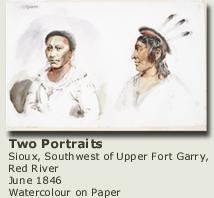
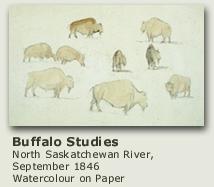
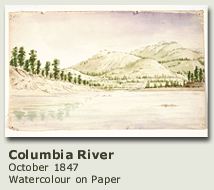
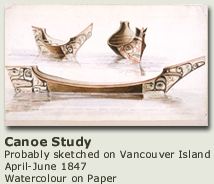
| | | | | | | | | | | | | | | | | | | | | | | | | | | | | | |  | | | | | | | | | | | "The principal object in my undertaking was to sketch pictures of the principal chiefs, and their original costumes, to illustrate their manners and customs, and to represent the scenery of an almost unknown country."1 | | | | | | | | | | | | | | | | | | Between 1845 and 1848, Paul Kane undertook two journeys travelling over water and land by canoe, foot, horseback, dog team, and snowshoes. From Toronto and the Great Lakes he travelled along the fur trade routes north of Lake Superior to Lake Winnipeg. Continuing along the North Saskatchewan River to Fort Edmonton he eventually reached the Columbia River and ultimately the Pacific Ocean. Throughout his journeys, he continued to make sketches of the Native Peoples he met and the landscape he crossed.
In the mid-nineteenth century, it was a common notion that the Native American was quickly disappearing and as such there was some urgency to record Native culture before it succumbed to the pressures of foreign expansion. In the United States especially, the tide of industrial development and national expansion rolled west under the title of "Manifest Destiny" and Native culture was destined to be replaced by European-derived civilization.
In 1844, American intellectual, Margaret Fuller, echoed this attitude when she wrote of the need to record the nation's Native Peoples before they departed: | | | | | | | | | | | | | | | | | | | | | "Yet, ere they depart, I wish there might be some masterly attempt to reproduce, in art or literature, what is proper to them, -- a kind of beauty and grandeur which few of the every-day crowd have hearts to feel, yet which ought to leave in the world its monuments, to inspire the thought of genius through all ages. Nothing in this kind has been done masterly...."2 | | | | | | | | | | | | | | | | | | | | | These words by Margaret Fuller put Paul Kane's effort into focus. His goal was to reproduce what was proper to Native Peoples, the beauty and the grandeur, and to leave in the world its monuments and to do it masterly. | | | | | | | | | | | | | | | | | | 1. Paul Kane, Wanderings of an Artist among the Indians of North America, Dover Publications Inc., Mineola, 1996, pp. lii-liii. 2. Margaret Fuller, Summer on the Lakes, in 1843. C.C. Little and J. Brown, Boston and Charles S. Francis and Company, New York, 1844, p.196. Also see http://courses.washington.edu/hum523/fuller/. | | | | | |